

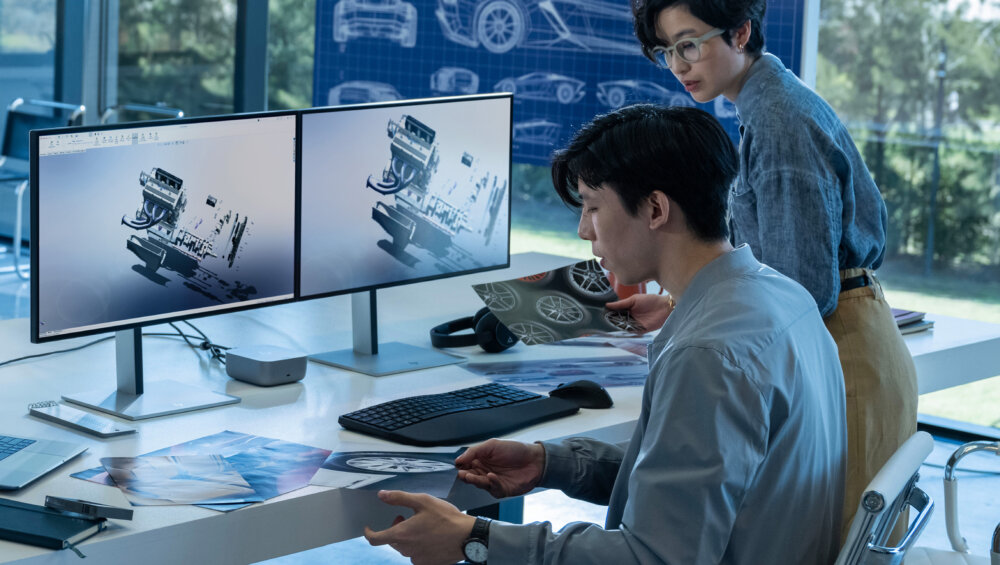

Modern laptops offer users good all-round performance and fantastic portability. New desktop PCs are combining high-end capabilities with impressive energy-efficiency in increasingly compact form factors. Yet neither can truly meet the requirements of the power users in your business. Only high-performance, workstation-class laptops and PCs can give them what they need for intensive workflows in design, 3D graphics, engineering and data science, not to mention cutting-edge AI.
Different roles and different software have different needs, but professional applications demand CPUs with high-levels of single-core performance and serious parallel processing power, handling 16 to 32 threads simultaneously.
They may need potent GPUs for real-time 3D rendering or previews, or to provide the raw compute muscle to wrangle demanding, data-heavy workloads. High-speed storage isn’t a nice-to-have but a must-have when working with large datasets or media files. The same goes for large quantities of high-speed RAM.
New AI tools are only adding to these demands. While the NPUs in new AI PCs are great for running low-level, everyday inferencing tasks on-device, AI power users need more performance for training and refining models, or to run demanding inferencing tasks.
Meanwhile, workers dealing with crucial IP and business-critical data must have robust security from the software stack down to the firmware layer. Management features are crucial, to ensure a steady flow of updates and rapid support should anything go wrong. Business-grade laptops and PCs may have these features, but power users need them in a powerhouse device.
Giving power users the PCs they need isn’t just smart; it’s a business imperative. HP’s 2025 Work Relationship Index report found that employees whose company gave them the technology tools they needed to be successful were substantially more likely to have a healthy relationship with work, and that businesses where more employees had such a relationship were more likely to report good business outcomes. What’s more, when most small and medium-sized businesses are struggling with skill gaps in data science, technology or AI, it makes sense to ensure that power users feel supported and engaged.
Luckily, workstation-grade laptops and PCs no longer have to be large, heavy, noisy or prohibitively expensive. Cutting-edge mobile workstations like the HP ZBook Ultra G1a deliver high-performance computing and graphics capabilities inside devices that support flexible, work-from-anywhere strategies. HP’s Z2 Mini G1a workstations offer incredible CPU, GPU and NPU performance and all the RAM power users could ask for, yet they come within a compact, unobtrusive and energy-efficient form factor.
Based on AMD Ryzen™ AI PRO and Ryzen™ AI Max+ PRO technologies, these machines provide 12 to 16 CPU cores running up to 32 threads at speeds of up to 5.1GHz, plus powerful integrated AMD Radeon™ GPUs with 16 to 40 RDNA™ compute units. They ensure power users can harness the biggest innovations in AI, data science and visualisation, even when they’re working from the smallest office – or from home. Plus, they offer the business-grade management and security features that enable small IT teams to stay on top of heavy workloads. By equipping your power users with high-end capabilities, your business can unlock a new wave of productivity. To find out more about HP’s workstations and what they could do for your power users, visit https://www.hp.com/gb-en/workstations/zbook-ultra.html.